
Is Stomach Tumor Curable?
Summary
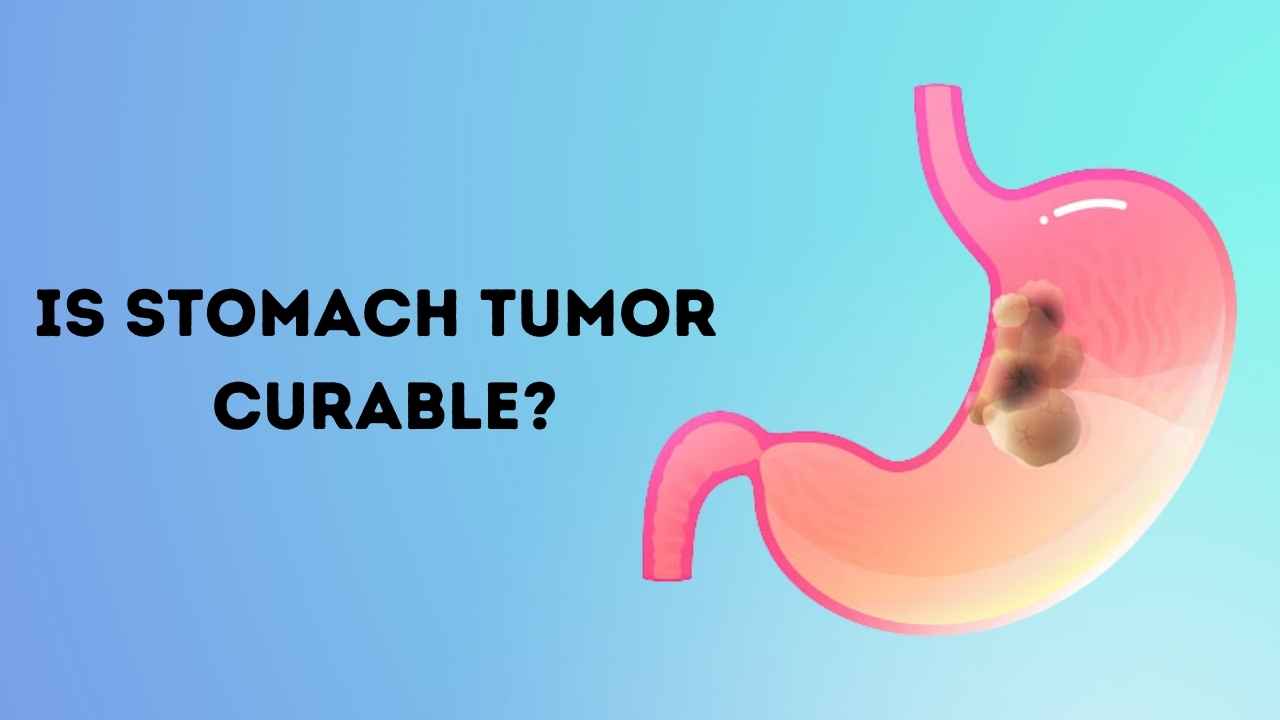
Yes, many stomach tumors can be cured, especially when found early. Whether a stomach tumor is curable depends on three things: the type of tumor, the stage (how far it has spread), and the patient’s overall health.
- Benign (non-cancerous) stomach tumors are usually cured by removing them.
- Early stomach cancer (Stage 1) has a very high cure rate when treated properly.
- Stage 2 and Stage 3 stomach cancer can be cured in many patients with surgery plus chemotherapy.
- Stage 4 stomach cancer (spread to distant organs) is rarely curable, but treatment can control it, reduce symptoms, and help patients live longer.
- Early diagnosis is the biggest factor in cure.
What is a stomach tumor?
A stomach tumor is an abnormal growth of cells in the stomach wall. Some tumors are harmless, and some are cancerous. As a surgical oncologist, I see both types in my clinic.
The common types are:
- Gastric adenocarcinoma: the most common stomach cancer, about 90% of cases.
- Gastrointestinal stromal tumor (GIST): a tumor that starts in the muscle layer of the stomach wall.
- Neuroendocrine tumor (NET): a slow-growing tumor from hormone-producing cells.
- Lymphoma: a cancer of the immune cells in the stomach.
- Benign polyps and growths: non-cancerous lumps.
Each type is treated differently, which is why a biopsy is so important.
Is stomach cancer curable at every stage?
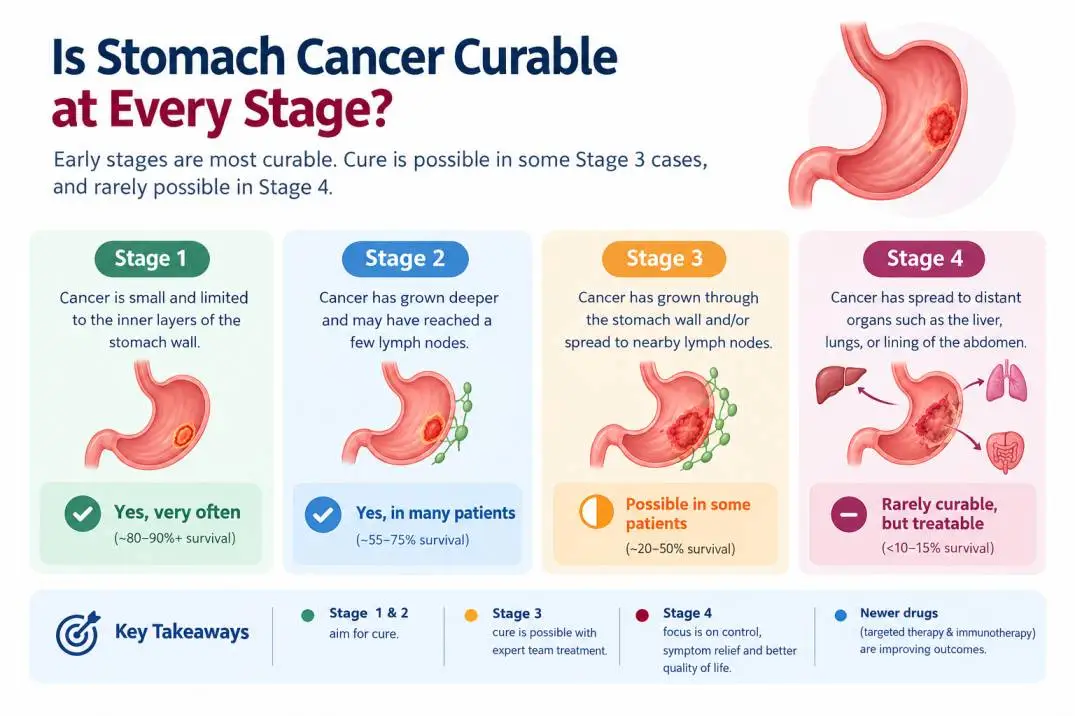
Stomach cancer is most curable in Stage 1 and Stage 2, can still be cured in many Stage 3 patients, and is rarely curable in Stage 4.
The goal of treatment in early and locally advanced cases is cure, meaning all the cancer is removed and does not come back.
In my practice, I explain the cure chances stage by stage:
| Stage | What it means | Is it curable? | Main treatment | Approximate 5-year survival* |
|---|---|---|---|---|
| Stage 1 | Cancer is small and limited to the inner layers of the stomach wall, with little or no lymph node spread | Yes, very often | Endoscopic removal (EMR/ESD) or surgery | About 80% to 90% or higher |
| Stage 2 | Cancer has grown deeper into the stomach wall and may have reached a few lymph nodes | Yes, in many patients | Surgery plus chemotherapy | About 55% to 75% |
| Stage 3 | Cancer has grown through the stomach wall and/or spread to many nearby lymph nodes, but not to distant organs | Possible in some patients | Chemotherapy, surgery, then more chemotherapy | About 20% to 50% |
| Stage 4 | Cancer has spread to distant organs such as the liver, lungs, or the lining of the abdomen | Rarely curable, but treatable | Chemotherapy, targeted therapy, immunotherapy, and symptom relief | Below 10% to 15% |
*These figures are approximate averages from large studies. They vary by country, hospital, tumor type, and patient health. They are higher in countries like Japan and South Korea, where screening finds cancers early.
⇒What these numbers mean for you:
- Stage 1 and 2 cancers are treated with the aim of cure.
- Stage 3 cancers need combined treatment from an expert team, and cure is possible.
- Stage 4 cancers are treated to control the disease, reduce symptoms, and help you live longer and better.
- New drugs, such as targeted therapy and immunotherapy, are improving outcomes even in advanced stages.
Your own outcome cannot be predicted from a table. Please discuss your exact stage and treatment plan with your cancer specialist.
Can an early stomach tumor be cured completely?
https://www.youtube.com/watch?v=2qxVnqsORDc
Yes, an early stomach tumor can often be cured completely. If the tumor is small and only in the inner lining of the stomach, I may be able to remove it through an endoscope without cutting the abdomen.
The main options for early tumors are:
- Endoscopic mucosal resection (EMR): removes small, superficial tumors.
- Endoscopic submucosal dissection (ESD): removes slightly larger early tumors in one piece.
- Surgery: if the tumor is deeper or the lymph nodes may be involved.
After removal, the pathologist studies the tumor under the microscope. If the report shows high-risk features, I may advise further surgery to be safe.
How is a curable stomach cancer treated?
Surgery is the main treatment that can cure stomach cancer. For most patients with cancer that has grown into the stomach wall, I combine surgery with chemotherapy.
The usual steps are:
- Diagnosis: endoscopy with biopsy to confirm the cancer.
- Staging: CT scan, sometimes PET-CT, endoscopic ultrasound (EUS), and laparoscopy to check for hidden spread.
- Chemotherapy before surgery: this shrinks the tumor and treats hidden cancer cells.
- Surgery: gastrectomy with removal of nearby lymph nodes.
- Chemotherapy after surgery: to lower the chance of the cancer returning.
- Follow-up: regular checkups, blood tests, and scans.
Newer treatments such as targeted therapy (for HER2-positive cancers) and immunotherapy are used in selected patients, based on tumor testing.
What kind of surgery is done for stomach cancer?
The surgery is called gastrectomy, which means removing part or all of the stomach. The type depends on where the tumor is and how big it is.
- Subtotal (partial) gastrectomy: removes the lower part of the stomach, used when the tumor is in the lower stomach.
- Total gastrectomy: removes the whole stomach, used for tumors in the upper or middle stomach, or very large tumors.
- Lymph node removal (D2 lymphadenectomy): the standard in expert centers, to clear nearby lymph nodes where cancer may have spread.
After surgery, the surgeon joins the remaining stomach or the food pipe directly to the intestine so that you can eat again. Many hospitals now offer laparoscopic or robotic surgery, which can mean smaller cuts and faster recovery in suitable patients.
Are non-cancerous stomach tumors curable?
Yes, benign stomach tumors are usually curable by removal. Not every stomach lump is cancer. Some are polyps, and some are small growths under the stomach lining.
Here is what I usually tell patients:
- Hyperplastic polyps: often linked to inflammation and H. pylori infection. Treating the infection and removing larger polyps is usually enough.
- Adenomatous polyps: these can turn into cancer over time, so I advise removing them.
- Small GISTs: need careful watching or removal, depending on size and features.
Even a benign tumor needs a proper checkup, because only a biopsy can tell the real type.
Is GIST of the stomach curable?
A stomach GIST can often be cured by surgery if it is found before it spreads. GIST behaves differently from stomach cancer. It is usually not treated with standard chemotherapy.
- Small, low-risk GISTs: may be removed by surgery alone.
- Higher-risk GISTs: surgery followed by a tablet called imatinib (a targeted drug), often for three years or more.
- Large or spread GISTs: imatinib can shrink the tumor and control it for many years.
GIST treatment is one of the success stories of targeted therapy in cancer.
What are the warning signs of a stomach tumor?
Early stomach tumors often cause no symptoms, or only mild ones that look like acidity. This is the main reason why many patients in India come late.
Please see a doctor if you have any of these for more than two to three weeks:
- Burning or pain in the upper abdomen
- Feeling full after eating very little
- Loss of appetite
- Unplanned weight loss
- Nausea or repeated vomiting
- Black stools or blood in vomit
- Difficulty swallowing
- Tiredness or paleness from anemia
- Swelling or a lump in the upper abdomen
These symptoms can also be caused by simple conditions like gastritis or ulcers. But if they do not go away with medicines, an endoscopy is needed.
Who is at risk of stomach cancer?
Long-term H. pylori infection is the biggest known risk factor for stomach cancer. Other factors also add to the risk.
- H. pylori infection
- Smoking and tobacco chewing
- Eating a lot of salted, pickled, smoked, or preserved foods
- Low intake of fresh fruits and vegetables
- Family history of stomach cancer
- Chronic gastritis or past stomach surgery
- Alcohol
- Obesity, mostly for tumors near the top of the stomach
- Certain inherited gene changes
Having risk factors does not mean you will get cancer. But it is a good reason to be careful and get checked if you have symptoms.
How is a stomach tumor diagnosed?
An upper GI endoscopy with biopsy is the key test to diagnose a stomach tumor. A thin tube with a camera goes through the mouth into the stomach. The doctor looks at the lining and takes small samples.
The tests I usually order:
- Endoscopy with biopsy: confirms whether it is cancer and what type.
- CT scan of chest, abdomen, and pelvis: checks for spread.
- Endoscopic ultrasound (EUS): shows how deep the tumor has grown.
- PET-CT: used in selected patients.
- Diagnostic laparoscopy: a small camera test to look for tiny spread in the abdomen.
- Tumor tests (HER2, MSI, PD-L1): guide targeted treatment and immunotherapy.
- Blood tests: to check hemoglobin, nutrition, and organ function.
What I Check Before Calling Stomach Cancer Curable ?
When I assess whether stomach cancer can be treated with curative intent, I look at these key points:
☐ Has the cancer spread to distant organs?
☐ Are the lymph nodes involved, and how extensively?
☐ How deeply has the tumor grown into the stomach wall?
☐ Can the entire visible tumor be removed safely?
☐ Does the biopsy confirm the exact type of stomach cancer?
☐ Have the relevant tumor markers been tested?
☐ Is the patient fit enough for the required treatment?
If the cancer has not spread to distant organs and all known disease can be completely treated, doctors may be able to treat it with curative intent. The final decision depends on the complete staging, biopsy and treatment assessment.
Can stomach cancer come back after treatment?
Yes, stomach cancer can return, even after successful treatment. This is called recurrence. Most recurrences happen in the first two to three years, but follow-up is advised for at least five years.
Follow-up usually includes:
- Clinic visits every 3 to 6 months in the first two years
- Blood tests, including vitamin B12 checks after stomach removal
- Endoscopy or CT scans when needed
- Regular nutrition checks
If you notice new symptoms like pain, weight loss, or vomiting, please do not wait for your next appointment.
Can I live a normal life after stomach surgery?
Yes, most patients return to a good quality of life after stomach surgery, with some changes in eating habits. The body needs time to adjust after part or all of the stomach is removed.
Simple tips I give my patients:
- Eat small meals, five to six times a day
- Chew food slowly and well
- Avoid very sugary foods to prevent dumping syndrome (dizziness and sweating after meals)
- Take protein with every meal
- Take vitamin B12 injections and other supplements if advised
- Walk daily and stay active
- Keep regular check-ups with your doctor and dietitian
How can I lower my chance of stomach cancer?
You can lower your risk by treating H. pylori, avoiding tobacco, and eating a healthy diet. Some steps are simple.
- Get tested and treated for H. pylori if you have long-term acidity or a family history of stomach cancer
- Quit smoking and tobacco
- Eat more fresh fruits and vegetables
- Reduce salty, pickled, and smoked foods
- Limit alcohol
- Maintain a healthy weight
- Do not ignore stomach symptoms that last more than a few weeks
- If stomach cancer runs in your family, speak to a doctor about early screening
When should I see a doctor?
See a doctor if stomach symptoms last more than two to three weeks or keep coming back.
Do not rely only on antacids. Please go sooner for black stools, vomiting blood, severe pain, or fast weight loss.
If you have already been told you have a stomach tumor, it is a good idea to meet a surgical oncologist who treats stomach cancers regularly.
Treatment planned by a team of surgeon, medical oncologist, radiologist, pathologist, and dietitian gives the best chance of cure.
Final Thoughts
A stomach tumor is not always a death sentence. Many are curable, especially when found early. The best steps are to get symptoms checked, get a proper diagnosis, and start treatment at an experienced center without delay.
Dr. Praveen Kammar is a surgical oncologist in India. This article is for general information and does not replace medical advice. Please consult your own doctor for diagnosis and treatment.
APPOINTMENT FORM

About Author
Dr. Praveen Kammar
Surgical Oncologist
12+
Years Of Experience
Dr. Praveen Kammar is a Best Surgical Oncologist in Mumbai. His main area of expertise aslso includes GI oncology, Gynecological cancers, minimal access surgeries, Robotics surgery, Laparoscopic Surgery, HIPEC.
Dr. Praveen has done more than 6000+ surgeries in his expertise.
Related Blogs

What Are the Types of Gastric Cancer?
Gastric cancer includes adenocarcinoma, lymphoma, and gastrointestinal stromal tumors. Diverse types demand tailored treatment approaches.
Should I Be Worried About Stomach Cancer?
Stomach cancer is a malignancy that develops in the lining of the stomach. It can be life-threatening if not treated early.